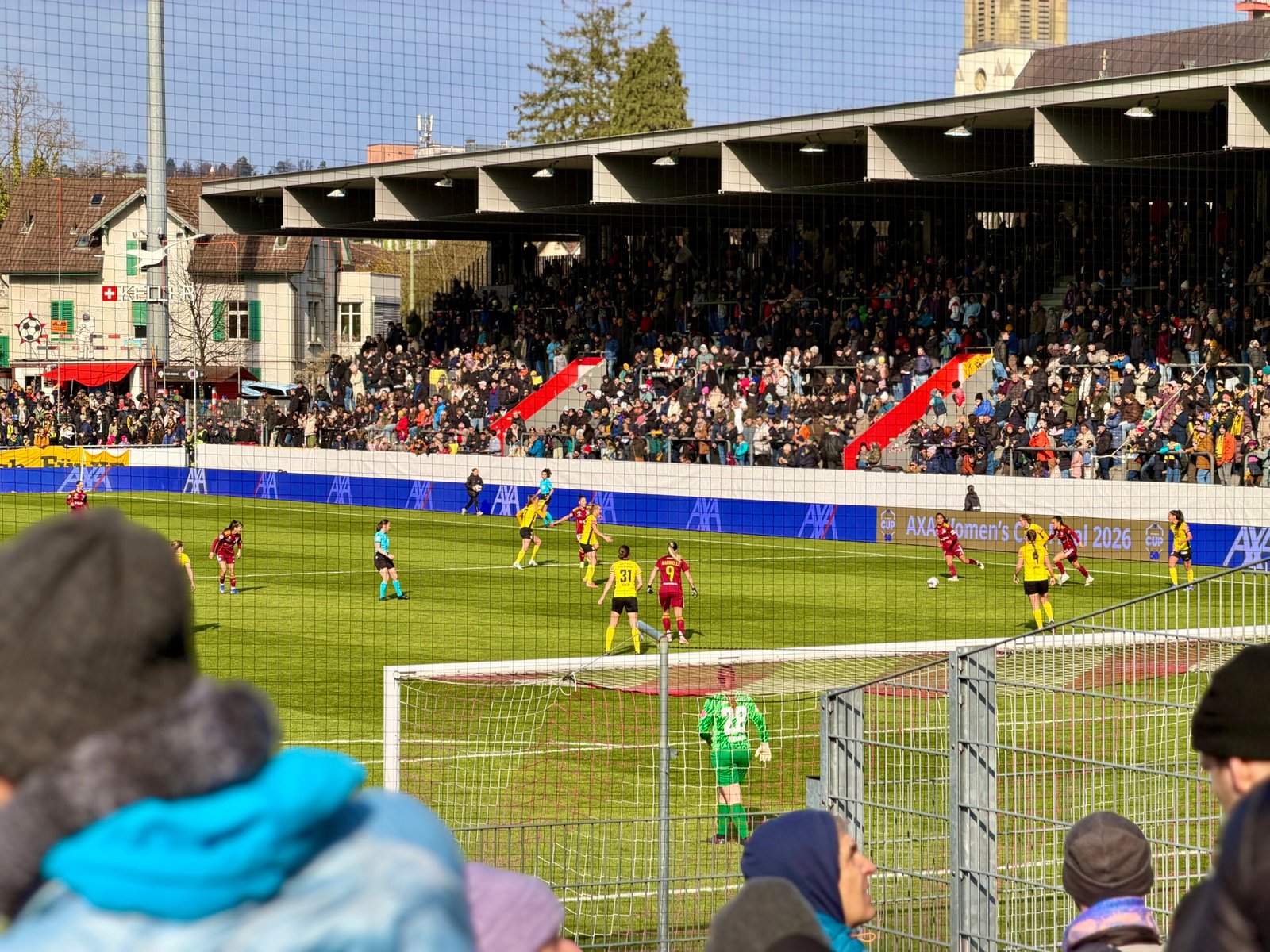
A monthly salary of under 500 Swiss francs and a side job at 80 percent employment – this is reality for most female “professional footballers” in Switzerland. A survey by Tamedia paints a clear picture of the precarious income situation in the Women’s Super League.
As part of an anonymous survey, Tamedia contacted all ten clubs in the Swiss Women’s Super League and received responses from 98 players about their salaries as professional footballers. The results are alarming. Despite growing attention around women’s football and rising attendance figures, the financial reality for many players has hardly changed.
89 of the 98 players surveyed are currently unable to live off football alone. Eight earn no salary at all, and more than half receive only between 80 and 500 Swiss francs per month. In total, 72 players earn less than 1000 francs per month, while only eleven earn more than 2000 francs, with a peak salary of 4500 francs. As a result, almost all players depend on additional employment: only two women stated that they do not pursue any other activity alongside football. Nine work less than 50 percent, while 68 players are additionally engaged at least 75 percent in work or education, such as university, secondary school, or an apprenticeship.
It is important to note that the survey was completed by 98 out of around 240 players in the league. While the overall picture may therefore be slightly less extreme, the study still clearly highlights how problematic the situation remains. It can be assumed that some clubs pay higher wages. Ramona Bachmann, who made a major transfer move from Houston Dash to YB last January, is likely the highest earner in the league. The 153-time Swiss international reportedly earns between 6000 and 7000 francs.
It is noticeable that foreign players generally earn higher salaries than Swiss talents. In the survey, one foreign player confirms that teammates earn “significantly less” than she does. Another statement adds: “Basically, only players from abroad can live off it.” GC captain Luna Lempérière also emphasizes that international players only come to Switzerland if attractive conditions are offered.
But what is left for local players? A closer look at the Tamedia survey results makes it clear that there are structural income differences between foreign and Swiss players in the league. This is concerning. Because how is Swiss women’s football supposed to grow if it is becoming increasingly unattractive for domestic talent? On the one hand, foreign players are preferred and can play under better conditions. This raises the question of whether the league is still fulfilling its core purpose of developing Swiss talent. Especially at top clubs, Swiss youth players often receive less responsibility and fewer opportunities. On the other hand, in many cases Swiss players are simply not able to fully focus on football. With an 80 percent workload alongside their so-called professional football career, there is barely any time left for recovery, let alone giving the body what it needs to perform at the highest level. Several players in the survey speak of a lack of recovery and a workload that may have long-term physical and psychological consequences.
In addition, there are structural problems within the league. Several players criticise insufficient training conditions, deficiencies in infrastructure and medical care, and a lack of professionalism in daily club operations. At the same time, high sporting performance is expected, even though many players continue to hold a main job alongside football.
It is therefore no surprise that most young Swiss players aim to move to a top-five league abroad as quickly as possible and view Switzerland only as a stepping stone. Because in countries like Germany, England or Spain, genuine professional structures already exist.
Recent examples of this development include top talents such as Sydney Schertenleib (FC Barcelona), Iman Beney (Manchester City), Noemi Ivelj (Eintracht Frankfurt), Lia Kamber (Union Berlin) and Leela Egli (SC Freiburg). All of them have already appeared for the Swiss national team at a young age, but moved abroad before turning twenty. As a result, the Swiss league often loses its biggest talents before being able to benefit from them sportingly or financially.
Looking at the current state of development, it becomes clear that talented players are not being offered a real perspective. Those who want to live from football have to go abroad. However, even if the level in Switzerland is not yet comparable to the top five leagues, initiatives are still needed to change the status quo. In response to Tamedia, the Swiss Football Association states: “In the long term, players in the top league should be able to work under professional conditions. The AWSL has made significant progress in recent years: structurally, sportingly and economically. The SFV is working specifically to further improve conditions together with the clubs.” The league is developing, and this is clearly not the final stage.
The fact is that Swiss women’s football is currently at a crucial stage. On the one hand, sporting quality is to be improved through more professional structures and international players. On the other hand, this development risks weakening the domestic talent pool in the long term. Because the domestic league should not only grow economically, but also serve as the most important development platform for Swiss talent.
If young players realize early on that they cannot find optimal financial or sporting conditions in Switzerland, they will inevitably look abroad for the next step. In the short term, this may benefit individual development, but in the long term it creates a structural problem for Swiss women’s football. The league loses its best players earlier and earlier, which leads to a loss of identification figures, sporting quality and continuity. At the same time, emerging Swiss talents receive less playing time and responsibility when clubs increasingly rely on foreign players to remain competitive.
This also has an impact on the national team. A strong national team is built on a stable domestic league, where young players regularly compete at a high level, take responsibility and develop step by step. If these opportunities are missing at home, development increasingly depends on abroad. As a result, Swiss football loses long-term influence over the development of its biggest talents and risks weakening the foundation for sustainable success in the national team.
The survey shows: Swiss women’s football stands at a crossroads. Without fundamental improvements in wages and structures, the league risks continuing to lose talent and weakening its role as a development platform. The question is whether it will be able to grow sustainably in the future or remain merely a stepping stone to playing abroad.
The full article and the corresponding survey can be found at the following link:
https://www.tagesanzeiger.ch/frauenfussball-schweiz-so-viel-verdient-eine-spielerin-109269637908