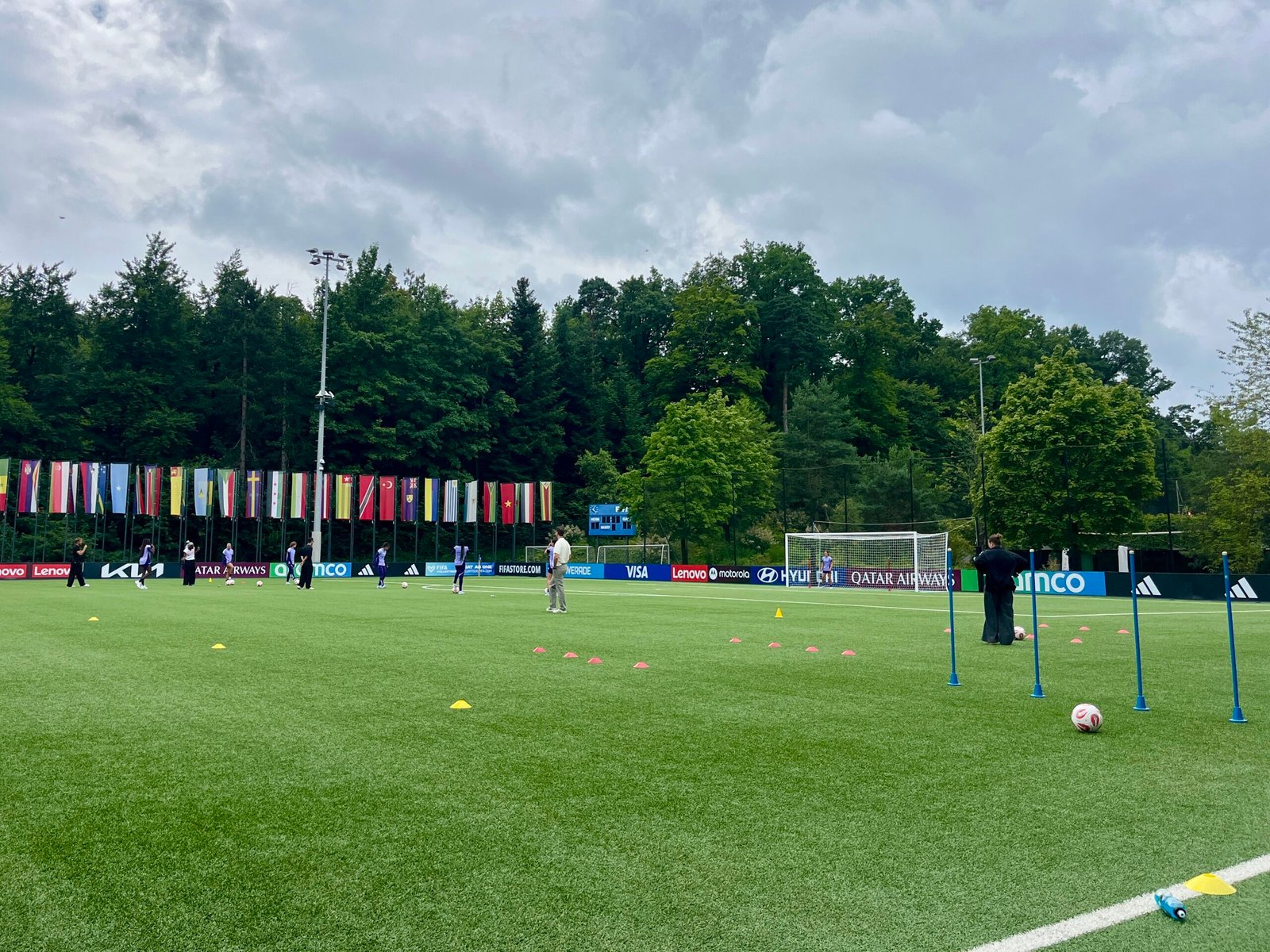
When I was nine years old, I started playing football. I loved the sport and also played outside of training, at home with my brothers or on the schoolyard. Whenever possible, I attended football camps during the holidays. One day, when I was about eleven, I was told that I was going to receive targeted support and should therefore move to a boys’ team. At that time, however, I did not want to play as the only girl in an all-boys team. It would have been my only chance to be optimally supported. Nevertheless, I declined the opportunity because I would not have felt comfortable in such an environment.
But the question remains: Is it really the case that girls can only be successful if they play in a boys’ team, or are there other ways today? In this article, I explore the controversial question of how girls can be optimally supported in football and whether it is necessary for them to play in boys’ teams.
Ulrike Ballweg, head of talent development in the women’s sector at the German Football Association and formerly long-time co-coach of the German women’s national team as well as coach of several youth national teams, believes that girls should play in boys’ teams for as long as possible. According to her, the majority of players in the national teams come from the youth programs where they were trained together with boys.
Under the direction of Bryan Charbonnet, five researchers from the University of Bern interviewed a total of 84 players who had been called up to the Swiss national team between 1990 and 2022. It turned out that almost all of them had trained with boys during their early development. The faster and more explosive style of play had a particularly positive effect on their sporting development. The players learned to assert themselves better, control the ball more quickly, and act more dynamically overall.
Although training with boys offers many sporting advantages, it also has its downsides. As a coach in elite girls’ youth football, I have repeatedly observed that many girls felt isolated and not accepted in all-boys teams. This can go as far as boys refusing to pass the ball to the girls. In addition, the girls often have to change alone in separate locker rooms, missing out on an important social aspect of the sport. Especially in the pre-pubertal and pubertal phases, this social factor should not be neglected. According to Ballweg, co-education makes little sense after puberty, as the physical differences become too large.
However, in recent years, women’s football has undergone significant development. Major tournaments such as the UEFA Women’s EURO 2025 in Switzerland have inspired many girls to take up the sport. As participation and diversity at grassroots level increase, the overall standard in elite girls’ teams continues to rise. At the same time, infrastructure, framework conditions, and investment are gradually improving. As a result, it is becoming increasingly possible for talented players to develop at a high level within all-girls environments, and without relying on boys’ teams.
Against this backdrop, Fabian Sanginés, head of women’s football at FC Basel, takes a critical view of co-education. He argues that it is no longer necessary for girls to train in boys’ teams, as was often the case in the past due to better coaching and conditions. Today, however, high-quality girls’ teams offer equally strong opportunities for development.
This perspective is supported by Heinz Reinders, head of the Women’s Football Academy at the University of Würzburg. A study conducted by his research team, involving 370 players aged 10 to 16 who were active in training centres or performance clubs, shows that girls in high-level girls’ teams develop comparable football-specific skills to those training in boys’ teams.
Despite these positive developments, significant structural challenges remain. Many clubs, particularly in Switzerland, struggle to provide qualified staff in the girls’ youth sector. This is not only a question of financial resources, but also of prioritisation within clubs. While boys in youth programmes often benefit from full-time coaching structures, similar levels of professionalisation are still lacking in the girls’ game. According to the Swiss Football Association (SFV), these deficits extend from club level to the national teams. There is a particular need for progress in areas such as menstrual cycle research and injury prevention, as well as in overall infrastructure and training conditions.
In response, the SFV is planning to establish additional high-performance centres for girls, alongside the existing centre in Biel, and to integrate talented players more systematically into the Footeco programme. Furthermore, the pilot project Footura currently supports 14 selected top players. Whether these measures will be sufficient remains to be seen in the coming years. However, if such developments continue, future generations of players may no longer face the dilemma of choosing between optimal development and personal comfort, but instead be able to grow in environments that combine both.
Overall, it is evident that girls can develop into successful footballers regardless of whether they train with boys or within all-girls teams. With increasing investment in the professionalisation of women’s football at club level, the necessary framework conditions are gradually being established to support high-level development within girls’ teams. At the same time, the growing number of teams in age categories such as U12 to U16 is contributing to a broader talent pool and a rising overall standard.
For the 2025/2026 season, the Swiss Football Association was able to introduce a national U16 women’s league for the first time, divided into two groups of eleven and twelve teams respectively. Until then, U16 women’s teams had to play in regional boys’ leagues. As a former U16 coach, I observed that the boys were often physically superior to the girls and that the teams rarely focused on structured build-up play as prescribed by the SFV’s training philosophy, instead relying more on kick-and-rush tactics. This often resulted in heavy defeats for the girls’ teams, while the young athletes could hardly benefit from the faster pace of the game. Thus, the introduction of a national U16 women’s league is a first step in the right direction.
It is therefore up to associations and clubs to professionalize elite women’s youth football and facilitate access to professional training for girls. Professional structures and framework conditions enable girls to train at a high level among themselves without being dependent on men’s football. The goal must be to prevent talented girls from leaving the sport simply because they do not feel comfortable in boys’ teams. The key question is no longer whether girls should play with boys, but whether the structures in girls’ football are strong enough to offer them equal opportunities. Only when this is the case will the choice truly belong to the players.
Sources:
Charbonnet, B., Schmid, M. J., Örencik, M., van Niekerk, E., & Conzelmann, A. (2024). The road to excellence in women’s football: a retrospective cohort study over the last 30 years with Swiss national players. Science and Medicine in Football, 8(4), 374–385. https://doi.org/10.1080/24733938.2023.2279531
NZZ. (2023). Wo ist die nächste Sidney Schertenleib? Welche Förderung Mädchen brauchen, um Profis zu werden. Neue Zürcher Zeitung. https://www.nzz.ch/sport/fussball/wo-ist-die-naechste-sidney-schertenleib-welche-foerderung-maedchen-brauchen-um-profis-zu-werden-ld.1909249
Reinders, H. (2022). Bedingungen erfolgreicher Förderung von Mädchen im Leistungsfußball. In Handbuch Fußball. Springer. https://doi.org/10.1007/978-3-658-27277-7_65