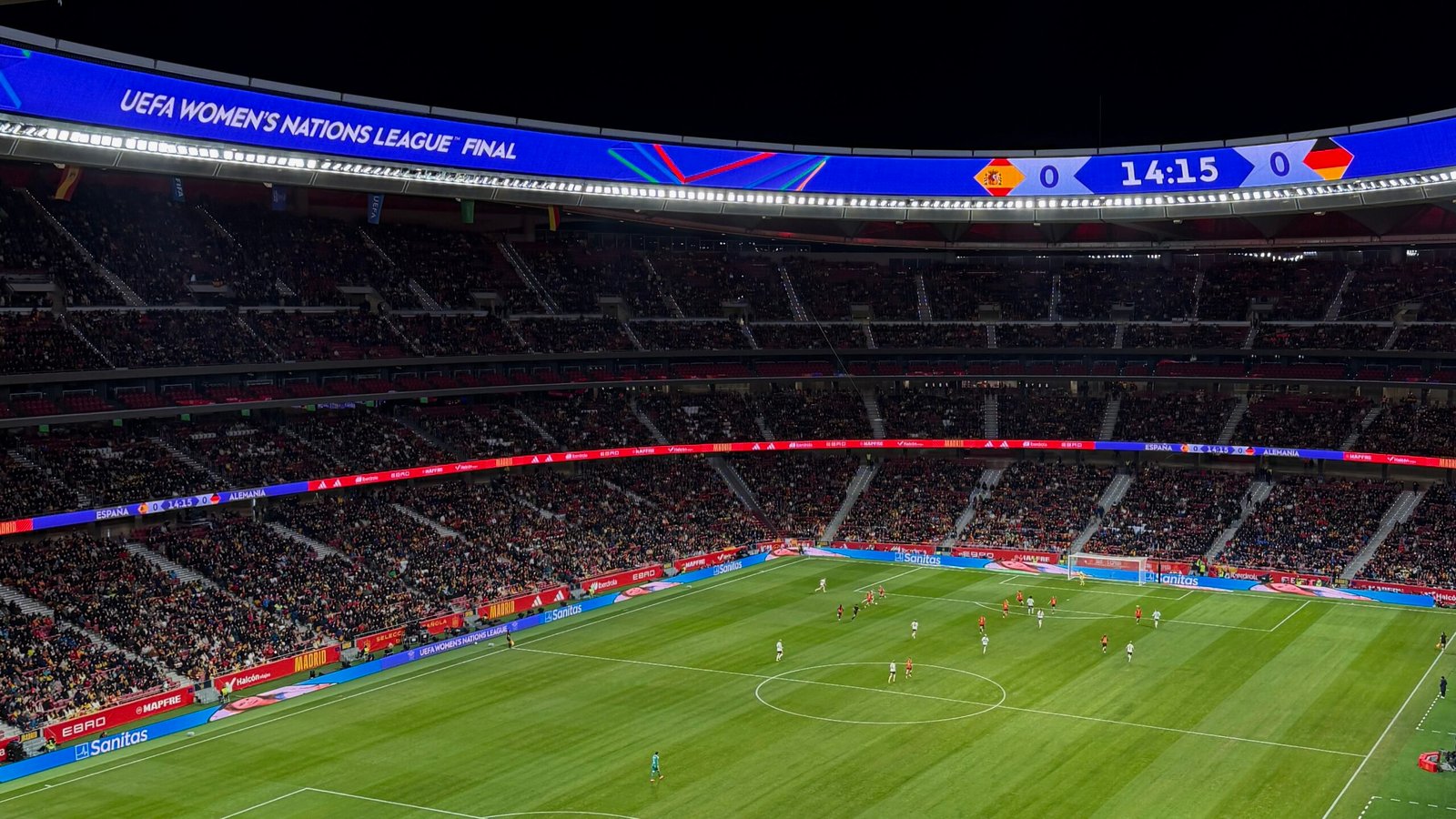
55’843 – that is the amount of people that showed up to the Estadio Riyadh Air Metropolitano to watch the second leg of the Women’s Nations League Final between Spain and Germany. While this number might be normal for a men’s football game in many countries, it is very special for women’s sport.
The world champions from Spain secured their second title in the second edition of the Women’s Nations League. After a 0:0 draw in the first leg in Germany, Spain delivered an impressive second-half performance in the return match in Madrid and won with 3:0. Claudia Pina, who scored twice, and Vicky López provided the stunning goals. The win did not only secure the trophy, but it signaled a landmark night for women’s sport, celebrated by over 55’000 fans in the stands. The match set new attendance records for a Women’s Nations League final as well as for a home game of Spain’s women’s national team.
Nights like these remind us how far women’s sport has come. It is no coincidence that thousands of spectators made their way to the stadium in Madrid on Tuesday evening. Not long ago, such important events involving female athletes were held on amateur pitches with tiny audiences. Even top clubs struggled with poor infrastructure and conditions and received little attention. The fact that this year marks only the second edition of the Women’s Nations League shows that we are still at the beginning of this journey.
Although conditions for female athletes in football all around the world are still far from equal to the ones men have, an incredible amount has happened in recent decades. Spectator records get broken regularly, whether at international level in the Nations League or at the EUROS, at the sold-out Camp Nou during the Champions League or at national competitions in pioneering countries such as England or Germany.
However, this steady increase in attention has not come out of nowhere. It is the result of years of investment, increased visibility and the tireless commitment of players, coaches, officials and fans who believed that women’s football deserved more. The more than 55’000 spectators at the Estadio Riyadh Air Metropolitano show that women’s football no longer has to fight for its legitimacy, but has long since earned its place in the sporting arena.
What’s more, moments like the Nations League final give young girls visible role models. The athletes show that ambition and excellence are not gender-specific and that every sport should be accessible to everyone. The high attendance figures challenge long-standing clichés about interest and demand. For decades, women’s sport was dismissed as something that supposedly no one wanted to watch. These packed stadiums prove the opposite. They show that audiences will come if women are given the stage, the investment and the visibility.
Next to me sat a little boy watching the game with his father. He was enthusiastically cheering on the German team. It was touching to see how excited he was about the women’s game. It shows that parents are bringing their children to these games, teaching them that women equally deserve their place on the biggest sporting stages. In this way, a new generation is growing up understanding that women can play sports and succeed at the highest level. It hasn’t always been like this, there was a time when women’s sports struggled for visibility and respect.
The atmosphere at the Estadio Riyadh Air Metropolitano thus reflected a cultural shift that goes far beyond a single match, a final or even a sport. It shows a world that is increasingly willing to see and appreciate women’s sporting achievements for what they are: absolutely worthy of filling a stadium.