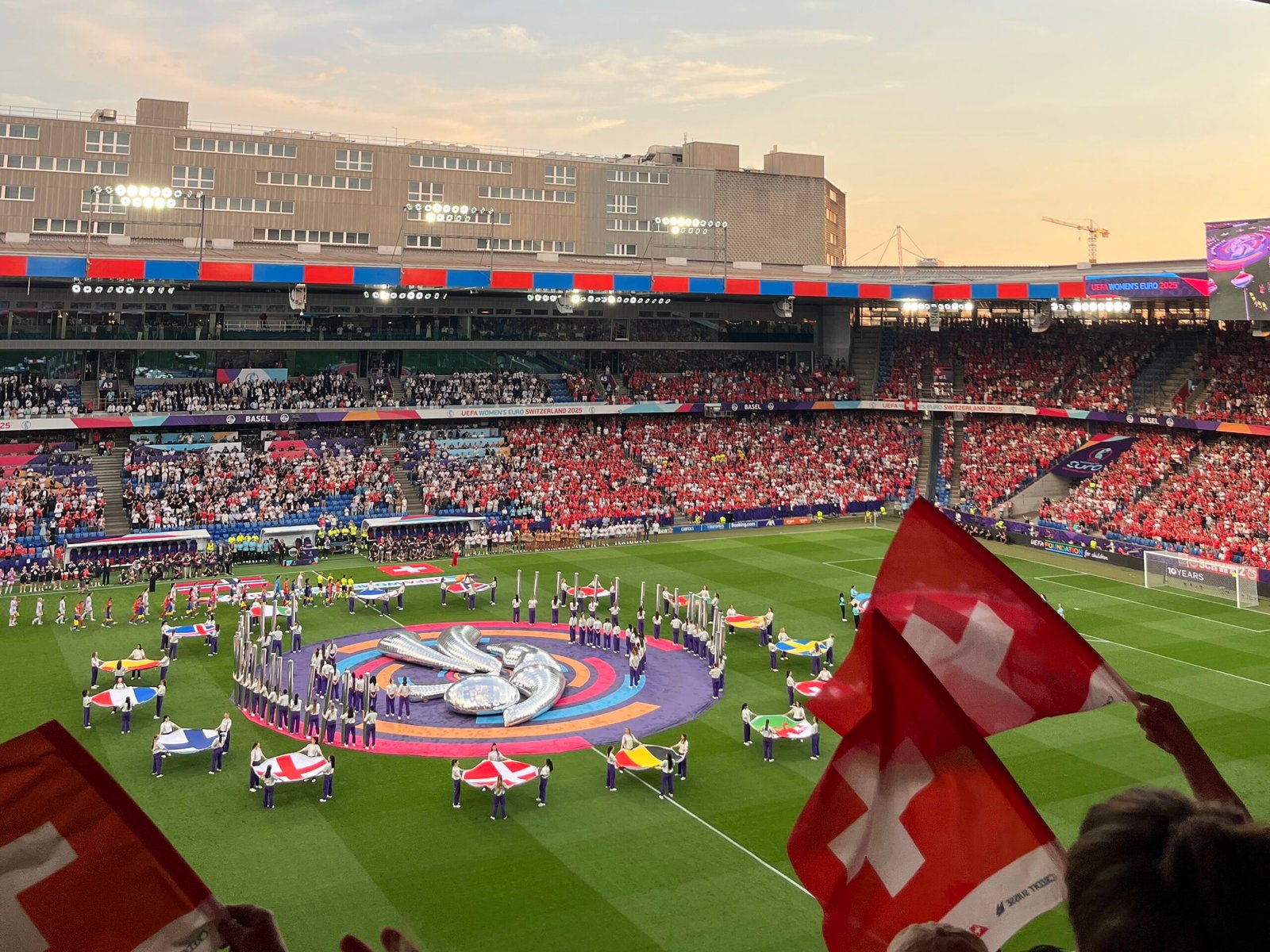
During July 2025, the UEFA Women’s EURO was held in my home country, Switzerland. The tournament sparked a level of euphoria across the nation I had never imagined possible.
When Switzerland was announced as the host of the Women’s EURO 2025 in April 2023, I doubted that my country could successfully stage a women’s tournament and fill the stadiums. The stated goal was to sell all 700’000 available tickets. Tournament director Doris Keller spoke of setting new benchmarks and breaking records, aiming to make this the largest women’s sports event ever in Europe. Many laughed at such claims about women’s football. Yet, as the tournament approached, ticket sales surged, making her ambitious goal attainable. In an interview with SRF at the start of the event, the 52-year-old said, “The tournament has the potential to advance Swiss women’s football by nearly a decade.” Few believed it, including me. And yet, she was right.
The first game of the tournament took place at St. Jakob-Park in Basel, Switzerland against Norway. Long before July 2nd, it was clear the match would sell out. Extra trains were packed, the city was filled with fans and Swiss jerseys were everywhere. When I stepped into the stadium, I could hardly believe my eyes. 38’000 fans had come to support our women, a sight I had dreamed of since I was a little girl. It was not just women and girls. Countless men and boys cheered alongside them.
Switzerland lost 2:1 to Norway, but the atmosphere remained electric. They bounced back to win their next game 2:0 against Iceland. Everything came down to the third and final group-stage game against Finland. A draw would be enough to advance to the quarter-finals. I watched the match at the official UEFA public viewing in Zurich, where I was volunteering for social media. As kickoff approached, more and more fans crowded around the big screen at the Europaallee. By the start of the game, the space was packed beyond capacity. People were standing shoulder to shoulder, watching from balconies and peeking over barriers. The venue was too small to fit all the fans that came to cheer on the Swiss women.
The score remained 0:0 with Pia Sundhage’s team pushing for a goal. The fans were calm because a draw would suffice. Then, in the 79th minute, chaos struck. Viola Calligaris fouled Finland’s Emma Koivisto in the box. The referee pointed to the penalty spot. Natalia Kuikka converted ruthlessly, giving the visitors a 1:0 lead. The Swiss fans grew anxious. Could this be the end of the nation’s fairytale summer? Then, in the 92nd minute, Géraldine Reuteler, playing the tournament of her life, sent a sharp ball into the box. Her assist found Riola Xhemaili, who slotted it home and sent Swiss fans into pure relief. The 1:1 equaliser secured Switzerland’s place in the quarter-finals. The Stade de Genève erupted, as did the public viewing in Zurich. Switzerland was celebrating. The journey continued.
Although the Swiss run ended in the quarter-finals against Spain, the tournament on home soil was nothing short of sensational. The Spaniards’ emotional gesture highlighted the Swiss team’s remarkable performance: The world champions formed a guard of honour for the hosts, paying tribute to them in style. It was a touching gesture for the Swiss to conclude their tournament.
Pia Sundhage’s team may not have won the trophy, but the hosts won the hearts of countless fans. I am certain many new supporters of women’s football joined along the way. The ride was not easy, but it brought the whole country together in a way I had only ever seen during major men’s sporting events, sparking nationwide euphoria. Several records were broken, from attendance numbers to fan engagement, proving the tournament’s massive impact. The magnificent fan march of 25’000 people in Bern, the largest ever in Women’s EURO history, was a testament to the nation’s dedication. In the end, tournament director Doris Keller had been right all along about the potential of the event to advance Swiss women’s football and capture the attention of the whole country.
The Women’s EURO in Switzerland gave me hope. Hope for greater acceptance, less discrimination, better opportunities and increased awareness for women’s sports. A movement for women in sport began in Switzerland during summer 2025, one I could never have imagined. It was truly a fairytale summer, on and off the pitch.